Has James Gun Been Hired Again?
I n the summer of 2019, months before the word "coronavirus" entered the daily discourse, Diljeet Gill was double-checking information from his latest experiment. He was investigating what happens when sometime human skin cells are "reprogrammed" – a process used in labs around the world to plow developed cells (heart, brain, muscle and the like) – into stem cells, the body's equivalent of a blank slate.
Gill, a PhD educatee at the Babraham Institute about Cambridge, had stopped the reprogramming procedure midway to run into how the cells responded. Certain of his findings, he took them to his supervisor, Wolf Reik, a leading authority in epigenetics. What Gill's work showed was remarkable: the aged pare had become more youthful – and by no pocket-size margin. Tests found that the cells behaved as if they were 25 years younger. "That was the real wow moment for me," says Reik. "I fell off my chair iii times."
A lot has happened since then. Last summer, Reik resigned as the director of the Babraham Institute to lead a new UK institute being built by Altos Labs, a contender for the most flush startup in history. Backed by Silicon Valley billionaires to the tune of $3bn (£ii.2bn), Altos has signed up a dream team of scientists, Gill and numerous Nobel laureates amid them. They will start work in the leap at ii labs in the Usa and one in the UK, with substantial input from researchers in Japan. Their aim is to rejuvenate human cells, not with an middle on immortality – as some reports have claimed – but to stave off the diseases of former historic period that inexorably drive the states to the grave.
"This is a field whose time has come," says Prof Dame Linda Partridge at University College London's Plant of Healthy Ageing. "I think what Altos will do is hugely accelerate the process of finding out whether it is going to evangelize or not. Nosotros need to see some clinical success stories."

Prof Janet Lord, director of the Found for Inflammation and Ageing at the University of Birmingham, is enthusiastic, too. "This is non near developing the start 1,000-year-old human; it's about ensuring old historic period is enjoyed and not endured. Who wants to extend lifespan if all that means is another xxx years of ill health? This is about increasing healthspan, not lifespan."
It is not the first time Silicon Valley billionaires take thrown their wealth at the ageing problem. In 2013, Google launched Calico – the California Life Company – with its own high-contour hires. With $1bn to burn, the secretive business firm began studying mice, which take an average lifespan of vi years, and naked mole rats, which, with a lifespan of 30 years, announced to have traded good looks for longevity. The visitor aims to map the ageing process and extend healthy lifespan, but has yet to produce whatsoever products.
Not that this has dampened Silicon Valley's expectations. In a microcosm shaped by large tech, ageing is framed as code to be hacked, with death merely a trouble to be solved. Peter Thiel, co-founder of PayPal and the big information analyst Palantir, has poured millions into anti-ageing research, notably the Methuselah Foundation, a non-profit that aims to make "xc the new 50 by 2030". As powerful computation is brought to touch biological science, Thiel has claimed it will be possible to "reverse all man ailments in the same way that we can fix the bugs of a computer program. Death will eventually be reduced from a mystery to a solvable trouble."
There is more to death than old age, of class. From the moment Homo sapiens arose, we take been cut down by acts of violence, accidents, starvation and affliction. To solve expiry would have far more than putting an end to ageing, but the billionaires seem less fired upwardly about solving poverty, war, famine, infant mortality, drug addiction and and so on.
Partridge finds phrases such as "solving ageing" and "solving death" wrong-headed. "Apart from being silly at the moment, it raises all kinds of societal issues. I think information technology's morally dubious. Huge things would percolate through society with a substantial increment in life expectancy brought nigh by human intervention," she says. "Nosotros're living longer and longer already. People are suffering from disability and loss of quality of life considering of ageing. That's what we should be trying to gear up. Nosotros should be trying to keep people healthier for longer earlier they drop off the perch. Stay healthy then drop expressionless, die in your sleep. I recall that's what most people want."
Thiel, who hopes to alive to 120, is one of the more than audacious advocates of anti-ageing therapies. 1 that caught his eye – although information technology is unclear if he has tried it – stems from a series of macabre experiments that plant the muscles, brains and organs of old mice were partially rejuvenated when they shared the blood of a immature animate being. (The younger animals, in return, appeared to age.) Scientists are however trying to establish which claret components are behind the effect, with a view to slowing dementia and other age‑related diseases. Just that didn't end a number of US firms from offering young claret transfusions for thousands of dollars – until the U.s.a. Food and Drug Administration intervened, alert consumers that there was "no proven clinical benefit".
Some other approach that has pulled in individual funders aims to flush worn cells from the trunk. When cells are damaged – for example, past toxins or radiation – they tin switch into a zombie-like country known as senescence. The process has benefits: senescence tin can shut down cells with mangled DNA and foreclose them from becoming tumours. But senescent cells cause trouble, besides: they accumulate in our bodies similar junk and release substances that ramp upwardly inflammation. This, in turn, drives diseases of quondam age.
In 2016, a Silicon Valley startup chosen Unity Biotechnology raised $116m from investors including Thiel and Amazon'southward Jeff Bezos to create therapies that flush out senescent cells. Unity's co-founder, Ned David, believes the drugs could "vaporise a tertiary of human diseases in the developed world". The show so far is encouraging. In 2018, James Kirkland, a researcher at the Mayo Dispensary in Minnesota, showed that "senolytic" drugs that destroy senescent cells not just improved the physical capabilities of aged mice, merely besides extended their lifespans. More than a dozen clinical trials are under way in humans, targeting osteoarthritis, Alzheimer's and frailty.
In case death turns out to be a hard nut to crack, Thiel and others take hedged their bets and signed upwardly with the Alcor Life Extension Foundation, which has been freezing bodies and brains of the dead since 1976. For about $200,000 and annual dues, the Arizona-based firm (motto: "A fulfilling life doesn't have to end") will keep your corpse on ice until science tin can reanimate yous. For those of more than minor means, Alcor will freeze your dead caput for $80,000. Lord, at the University of Birmingham, describes the procedure as "total basics".
Altos emerged from stealth style last month, with the Russian-Israeli tech billionaire Yuri Milner a confirmed capitalist. Bezos is rumoured to be involved, too. Clearly, they hateful business organization. The chief scientist and co-founder, Rick Klausner, is the former caput of the United states National Cancer Institute, while the master executive, Hal Barron, left a role at GlaxoSmithKline that paid more than £8m a twelvemonth.
B ut what is it with middle-aged male person billionaires and anti-ageing research? Has the penny dropped that they, as well, will one day fade away? Is rejuvenation science poised to swell their fortunes farther? Or – and sense of humor me for a moment here – could this be most the greater adept?
Asked about the trend later Calico launched, Bill Gates was scathing: "It seems pretty egocentric while nosotros still accept malaria and TB for rich people to fund things so they tin can alive longer," he told an "enquire me anything" forum on Reddit. Perhaps the motivation doesn't affair. Lord says: "Nosotros've got an ageing population, but we are living longer without living healthier. If you are going to do something with your squillions, information technology's as good a target as any."
Prof Lorna Harries, a molecular geneticist at the University of Exeter's medical schoolhouse, agrees. "There's nothing like increasing age to brand you aware of your own mortality. I think the urge to extend your life as long as possible is something that'south behind a lot of this," she says. "Merely I'thou glad they're putting their money into something that I think will have very tangible benefits down the line. If you lot are really deadly serious nigh getting things into the clinic, this is not something nosotros are going to be able to do on academic grants."
Altos's Cambridge Institute of Scientific discipline is under construction at Granta Park, a landscaped 120 acres south of the metropolis that is home to AstraZeneca, Pfizer and Illumina, a gene-sequencing business firm. The first researchers are due to arrive in May. Two more than institutes are being fix in San Diego and the San Francisco Bay Expanse, with further back up coming from Prof Shinya Yamanaka, a Nobel prizewinning stem-jail cell scientist at Kyoto Academy in Nippon.
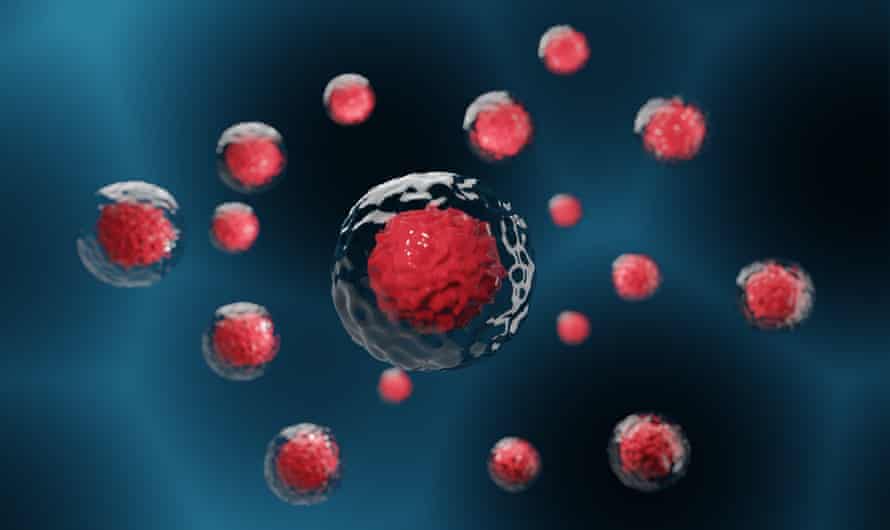
One area Altos volition explore is called the integrated stress response (ISR). When cells in the body become stressed by, say, a viral infection, a lack of oxygen, or the buildup of malformed proteins, the ISR can reboot the cell's protein-making mechanism. It is the biological equivalent of the IT department's "turn it off and on again". If this doesn't work, the ISR tells the cell to self-destruct: the biological equivalent of chucking your laptop in the bin.
In the past decade, scientists have discovered that the ISR is involved in a host of age-related diseases, including Alzheimer's. In December 2020, Peter Walter, who will run Altos'south Bay Area institute, showed that drugs can retune the ISR and rapidly restore youthful cognitive powers to aged mice. If naught else, Altos is good news for over-the-hill rodents.
Another expanse in which Altos hopes to make headway is rejuvenating the allowed organisation. As nosotros age, our allowed system weakens, leaving united states more decumbent to cancer and infections. Part of this is driven by changes in the thymus, a gland the size of an oyster that sits between the lungs. The thymus is where the immune arrangement'southward protective T cells go to mature, simply from puberty onwards it shrinks and is steadily replaced by fat.
Steve Horvath, a homo-genetics professor who is moving to Altos from the Academy of California, Los Angeles, establish show in a minor clinical study that a growth hormone, taken with ii anti-diabetes drugs, tin regenerate the thymus and reverse a person'due south biological age. A therapy based on the work might assistance forestall cancer and make eldery people more resilient to infections.
Central to Altos'south vision is a process called cellular reprogramming. With every human birth, biology demonstrates its rejuvenative powers by turning the onetime cells from parents into the youthful tissues of a newborn. In 2006, Yamanaka created a like upshot in the lab. He found that activating 4 genes in pare cells transformed them into an embryonic state, from which they could grow into the body'south numerous tissues. The piece of work fuelled a wave of interest in growing spare parts for patients, but the procedure has its risks: activate the "Yamamaka factors" inside living animals and they can develop teratomas – tumours made due to a grim confusion of different cell types.
Scientists are refining the process, winding back the clock just plenty to brand cells youthful, but not cancerous. In one landmark study, Juan Carlos Izpisua Belmonte, a developmental biologist who will lead the Altos establish in San Diego, showed that switching on Yamanaka factors for a half-dozen-week burst rejuvenated old mice and extended their lifespan past nearly one-third. "With careful modulation, ageing might be reversed," he says.
The same fob would be hard to pull off in humans. Instead, the hope is to find new biological pathways that, when targeted with drugs, rejuvenate old or senescent cells without causing cancer. Scientists such as Reik and Gill plan to explore these mechanisms in detail, drawing on sophisticated biological clocks to measure out how much they turn dorsum time on aged cells. The dazzler about targeting ageing itself is that a therapy that helps to forbid ane disease might well practise the same for others.
"If y'all've got the rights to something that works for dementia, a huge public health trouble, which you can then turn around and apply to cardiovascular disease, or stroke, or osteoarthritis, that is going to make someone a lot of money," says Harries, who is also the director and co-founder of Senisca, a biotech spin-off of the University of Exeter that is developing "senotherapeutics" to opposite senescence.
In that location are no guarantees of success, of course, simply that is the nature of medical research. "What excites me about Altos is that information technology's a new way to do science," Reik says. "It appeals to me because you can reach so much more in a bigger squad. We want to knuckle down."
cotterlialling1969.blogspot.com
Source: https://www.theguardian.com/science/2022/feb/17/if-they-could-turn-back-time-how-tech-billionaires-are-trying-to-reverse-the-ageing-process
0 Response to "Has James Gun Been Hired Again?"
Enregistrer un commentaire